
The variety of natural stone available in Poland and neighbouring regions makes material selection the most consequential decision in any paving project. Surface durability, frost behaviour, slip resistance, and visual character all differ between stone types, and these differences become apparent over the first few freeze-thaw seasons.
Why Stone Type Matters for Polish Conditions
Poland's climate involves regular frost from November through March, with temperatures often cycling above and below 0°C multiple times during that period. Water absorbed by porous stone expands as it freezes, widening micro-fractures with each cycle. After several winters, this mechanism can produce visible surface spalling or full stone cracking.
Frost resistance is measured by absorption rate — the percentage of the stone's volume taken up by water after immersion. The European standard EN 12371 tests freeze-thaw resistance directly. For vehicle-area paving, stones with absorption below 0.5% are preferred. Pedestrian paths in sheltered positions can tolerate slightly higher absorption.
Granite
Granite is the most widely used stone for hard paving in Poland. It is available in sett form (typically 10×10×10 cm or 8×8×8 cm) from quarries in Lower Silesia — particularly around Strzelin, Strzelce Opolskie, and Sobótka. These quarries supply both new stone and, when street renovation projects generate surplus, reclaimed material.
Granite's compressive strength and near-zero water absorption make it suitable for driveways carrying regular vehicle traffic. Surface finish affects slip resistance: sawn faces are smooth and can become slippery when wet; split or flamed surfaces have more texture and are safer for pedestrian use in damp conditions.
Surface finishes available
- Split (natural cleft): Irregular texture from the quarrying process. Good slip resistance. Most common for traditional cobblestone appearance.
- Sawn: Flat, consistent surface. Easier to lay precisely. Can be slippery when wet unless given additional treatment.
- Flamed (thermal): Heat-treated to open the surface slightly. Improves grip. Used on steps and sloped areas.
- Sandblasted: Uniform matte texture. Good for terrace areas where a more refined look is wanted.
Sandstone
Świętokrzyskie sandstone — from the Holy Cross Mountains region in central Poland — has been used in Polish architecture for centuries. It is softer than granite, which makes it easier to cut and shape on site, but also means it wears faster under vehicle loads and is more susceptible to frost if not properly sealed.
Sandstone is well-suited for garden steps, terrace paving in sheltered areas, low-traffic paths, and decorative wall cladding. Its warm ochre and grey-brown tones are distinct from granite and work well with older building styles.
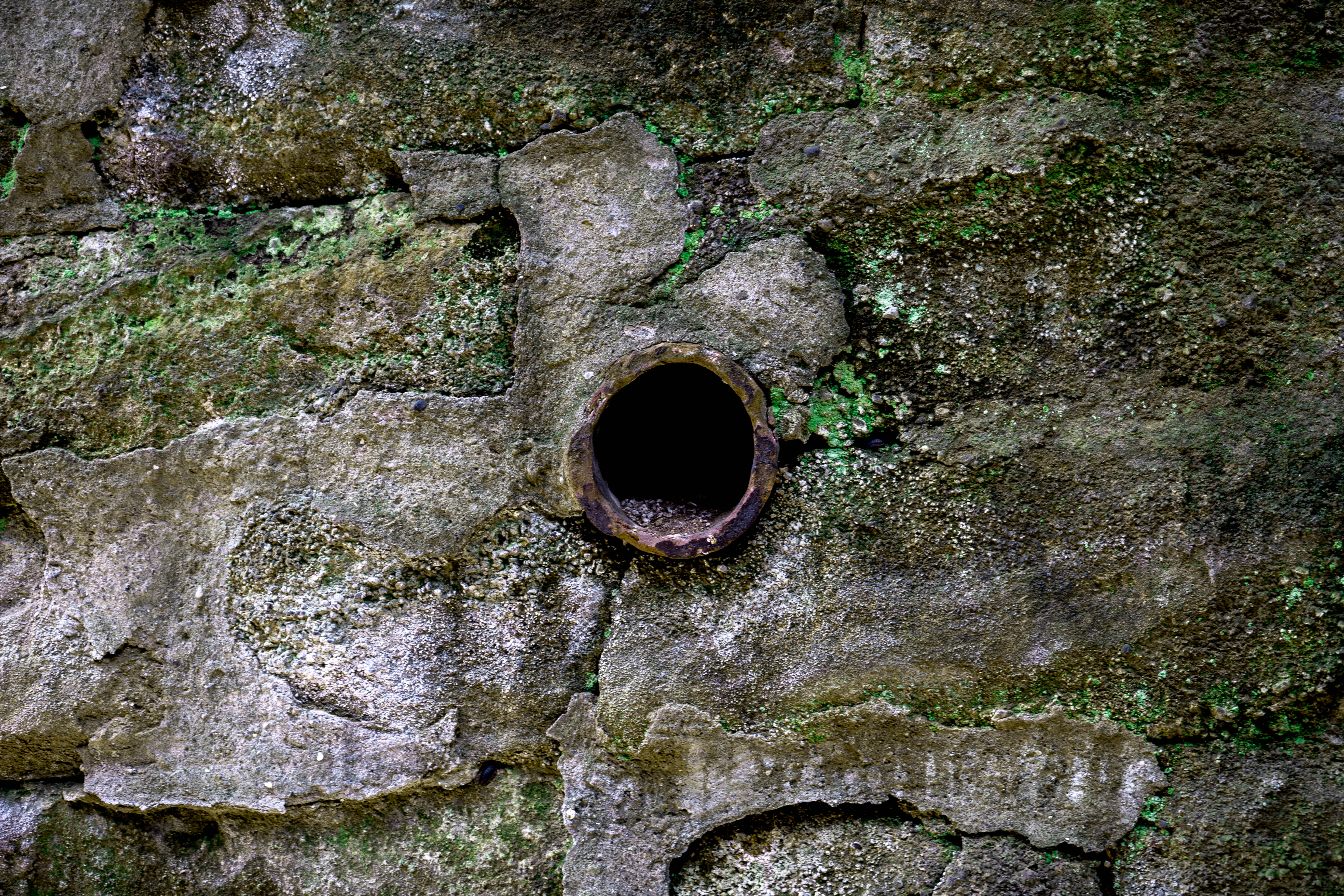
Drainage integration in stone masonry — a detail relevant to both wall construction and surface paving near structures. Source: Wikimedia Commons (CC BY-SA).
Basalt
Basalt is available in Poland primarily through import from the Czech Republic and Slovakia, though some Polish deposits exist. It is very hard, dense, and highly frost-resistant. Its dark colour — almost black when wet — gives it a distinct appearance.
Basalt setts are used in higher-end residential projects and in urban streetscaping. The material cost is higher than granite, and the hardness makes on-site cutting difficult without diamond blades. For standard rectangular sett formats, this is rarely an issue; custom cutting for complex patterns adds time and cost.
Limestone
Limestone is softer and more porous than the other options listed here. Polish limestone from the Kraków-Częstochowa Upland has decorative uses in garden design — raised beds, feature walls, and informal path edging — but it is not typically specified for main traffic surfaces exposed to full winter conditions without sealing.
When used in paving, limestone performs better in covered or sheltered areas, or in climates with fewer freeze-thaw cycles than central Poland typically sees.
Comparison by Key Properties
| Stone | Frost Resistance | Vehicle Traffic | Availability in PL | Relative Cost |
|---|---|---|---|---|
| Granite (Silesian) | Very high | Suitable | Widely available | Medium |
| Sandstone (Świętokrzyskie) | Moderate | Pedestrian areas | Available regionally | Low–medium |
| Basalt (imported) | Very high | Suitable | Import only | High |
| Limestone | Low–moderate | Not recommended | Available | Low–medium |
Reclaimed Stone
Street renovation projects in Polish cities regularly generate large quantities of reclaimed granite cobblestones. Stone yards in urban areas collect and sort this material, which is then sold at lower prices than new stone. Sizes tend to be inconsistent — reclaimed stone from different decades of road construction can vary by several centimetres — which requires more careful sorting before laying.
For informal garden paths and areas where slight variation in surface level is acceptable, reclaimed granite is a practical and cost-effective choice.
Practical Sizing Notes
The most common sett sizes in Polish residential projects are 10×10×10 cm (a large format that lays quickly) and 8×8×8 cm (finer grid, more visible joints). Smaller setts such as 4×4×4 cm are available but are slower to install and are more commonly seen in historic city centres than in new residential work. Larger formats — 15×15 or 20×20 cm — reduce joint count and are sometimes specified for driveways where a cleaner appearance is wanted.
Related reading: Cobblestone Laying Techniques and Driveway and Path Design with Granite Setts.

